

EXTRAORDINARY ABILITY · IMMIGRATION LITIGATION
Federal court representation when USCIS gets it wrong.
DC Federal Litigation, led by Sherrod Seward, Esq., files complaints in federal court when O-1, P-1, and EB-1A petitions are denied against the regulations and the precedent. We don’t appeal to USCIS. We bring the agency to federal court — and we have sued the federal government in our own name.
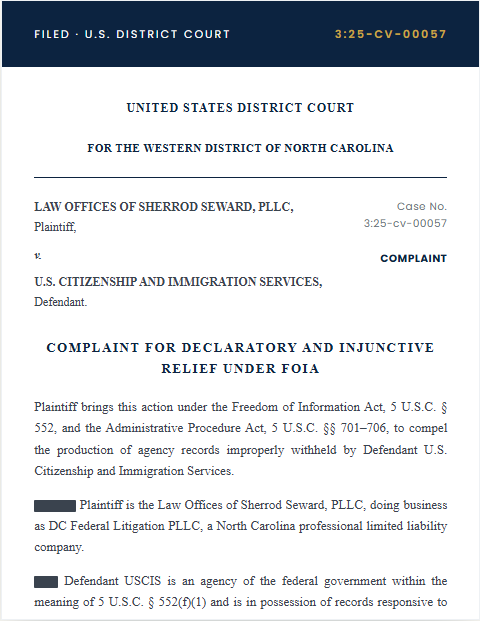
The firm doesn’t just talk about federal litigation — it files in its own name and wins. A FOIA action filed against USCIS in 2025 (W.D.N.C., 3:25-cv-00057) sits on the firm’s active docket. Prior P-1 federal complaints have produced USCIS reversals before responsive pleading, including a 2022 matter dismissed after the agency approved the petition under the federal court’s shadow.
AILA Publications Contributor · U.S. District Court, D.C. · U.S. Court of Federal Claims · U.S. Court of Appeals, D.C. Circuit · United Nations MIPAD Nominee, 2018Agent-petitioned O-1, P-1 & federal litigation work — including matters for and on behalf of:











The USCIS Problem
The administrative process isn’t designed to give you a yes.
USCIS issues Requests for Evidence and Denials that demand evidence beyond what the regulations require. Agents and athletes get “no relationship with the event” objections that aren’t anywhere in 8 C.F.R. Petitioners get told their evidence “doesn’t establish” eligibility under standards USCIS invented for the file. The federal precedent says the agency cannot do this. They do it anyway — until someone files in federal court.
i
The Kazarian standard
Federal precedent governs every adjudication: the agency may not invent substantive or evidentiary requirements that go beyond the published regulations. USCIS adjudicators routinely violate this standard — and the violation is reviewable in federal court.
Kazarian v. USCIS, 596 F.3d 1115 (9th Cir. 2010)
ii
Preponderance of the evidence
The actual statutory standard for O-1, P-1, and EB-1A petitions. Not “clear and convincing.” Not “beyond all doubt.” More likely than not — and a petitioner only needs to satisfy a small number of regulatory criteria. RFEs that demand more are RFEs the agency had no authority to issue.
Matter of Chawathe, 25 I&N Dec. 369 (AAO 2010)
iii
Agent-petitioner structure
Established by statute and regulation. A U.S. agent may file an O or P petition on behalf of a foreign employer with full authority to do so. USCIS is required to follow the structure as written — but routinely denies on speculative “relationship with the event” theories that have no regulatory basis.
INA § 214(c)(5)(B); 8 C.F.R. § 214.2(o)(2)(iv)(E), (p)(2)(iv)(E)
The Federal Court Reframe
You don’t need a better appeal.
You need a different forum.
The Administrative Appeals Office reviews USCIS denials under the same lens that produced them. Same agency, same culture, same evidentiary instincts. The appeal asks a new adjudicator to find the old adjudicator was wrong — but the questions and the assumptions stay the same.
Federal court applies a different standard entirely. Under the Administrative Procedure Act, the question becomes whether the agency’s action was arbitrary, capricious, an abuse of discretion, or otherwise not in accordance with law. 5 U.S.C. § 706(2). Different standard. Different forum. Different leverage.
And the record opens up. The certified administrative record comes out of USCIS’s file room and onto the docket. Deliberative materials become discoverable. Settlement conversations begin. Many cases never reach summary judgment because USCIS — once the file is in front of a federal judge — quietly remands and reopens.
Article III judge
An independent federal judge applying federal precedent — not a USCIS adjudicator applying the agency’s house view of its own regulations.
APA review standard
Arbitrary, capricious, abuse of discretion, or contrary to law. The standard the agency must satisfy — not the standard the petitioner must clear.
Discoverable record
The certified administrative record is filed with the court. Internal communications and evidentiary reasoning become reviewable, not buried.
Settlement leverage
Consent remand, stipulated reopening, and negotiated approval are realistic outcomes once the file is on a federal docket. They are not realistic at the AAO.
How We Work
From denial to district court.
Three steps. Predictable engagement, predictable cost, predictable timeline. The path from a USCIS denial to a federal court complaint is shorter than most attorneys think — and the leverage starts the day the complaint is served.
i
Executive Consultation
Sixty-minute review with Sherrod Seward, Esq. $500 — credits 100% toward your retainer if we engage. We read the denial, the original petition, and the RFE record. We tell you whether federal court is the right move, what the case looks like, and what the timeline is.
ii
Engagement & Filing
On engagement, we draft and file your federal complaint in the appropriate federal district court. We serve USCIS, secure the certified administrative record, and assemble the case for review under the APA.
iii
Litigation Through Resolution
Discovery, motions practice, summary judgment briefing, settlement negotiations. Many federal court immigration cases resolve via consent remand — USCIS reopens, applies the regulations as written, and the petition is approved. Others go to judgment.
Federal Filings
Cases the firm has taken to federal court.
Public dockets only. Past matters illustrate the firm’s litigation framework. Outcomes depend on facts and applicable law and do not predict results in any specific case. Identifying details limited to information already in the public record (PACER, public press releases, or media reporting).
i
Active · Firm as Plaintiff
Law Offices of Sherrod Seward, PLLC v. USCIS
W.D.N.C. · 3:25-cv-00057 · Filed Jan. 2025
A FOIA action filed in the firm’s own name against USCIS to compel production of records the agency declined to release. When the firm needs the agency to open its file room, it sues the agency. Public docket on Justia →
FOIA · Active
ii
USCIS Reversed
P-1 Mixed Martial Arts — USCIS Approval Following Federal Filing
S.D. Fla. · 1:22-cv-21609-RNS · Voluntarily dismissed Jun. 2022
Federal court complaint filed against USCIS challenging a P-1 MMA denial. The agency reversed and approved the petition before answering the complaint. Case voluntarily dismissed after approval. Public release →
P-1 · MMA · Approved Post-Filing
iii
Agent-Petitioner P-1A Athlete Litigation
C.D. Cal. · 2:22-cv-06130 · Filed Aug. 2022
Federal court complaint under the APA challenging a USCIS denial of a P-1A petition based on extra-regulatory “relationship with the event” requirements. Brief grounded in Kazarian v. USCIS, 596 F.3d 1115 (9th Cir. 2010), and the agent-petitioner regulatory framework at 8 C.F.R. § 214.2(p).
P-1A · Agent for Foreign Employer
iv
P-1 Boxing — Agent-Petitioner Litigation
Federal court · P-1 boxing matter
Federal court complaint challenging a USCIS denial of an agent-petitioned P-1 boxing matter on grounds outside the regulatory framework. Reframes the agent-petitioner relationship under INA § 214(c)(5)(B) and 8 C.F.R. § 214.2(p)(2)(iv)(E).
P-1 · Boxing
v
Public Reporting
Tevaughn Campbell — NFL P-1 Visa Restructured to Agent
Federal practice · Front Office Sports, Nov. 2022
Restructured a NFL defensive back’s P-1 visa to tie to his agent rather than his team, eliminating the international travel cycle that occurred at every contract turn. Front Office Sports coverage →
P-1 · NFL · Public Reporting
vi
P-1 Multi-Petition Federal Framework
Federal court · multiple matters
Repeat federal court challenges to USCIS’s pattern of denying agent-petitioned P-1 petitions for internationally ranked athletes on grounds the regulations do not authorize. One legal theory across multiple matters — built for replicability.
P-1 · Pattern Litigation
“I’m proud of the fact that we sued the federal government and won, and that we can help a lot of fighters realize their dreams.”
— Malki Kawa, CEO, First Round Management · Licensed NFL Agent
We Also Handle
Federal court work beyond immigration.
The same federal court admissions and the same APA framework apply across the firm’s other practice areas. When agencies overreach, federal court is where the law is enforced.
Government Contracts
Tucker Act claims, bid protests at GAO and the Court of Federal Claims, SBA 8(a)/HUBZone/SDVOSB/WOSB certification appeals, and suspension and debarment defense.
EPA & Environmental
Permit challenges, enforcement defense, and regulatory review in the D.C. Circuit and federal district court when EPA acts outside its statutory authority.
OFAC & Sanctions Litigation
Suing OFAC over specific license application delays, SDN delisting
actions, and writ of mandamus petitions when the agency sits on a file
past any reasonable period.
FOIA & Transparency
FOIA litigation when agencies refuse to comply, stonewall production, or claim exemptions that don’t apply. Recovery of attorneys’ fees where the statute permits.

About the Firm
Sherrod D. Seward, Esq.
Founder, DC Federal Litigation.
Sherrod Seward is the Managing Attorney of the Law Offices of Sherrod Seward, PLLC, doing business as DC Federal Litigation PLLC. The firm focuses on federal court representation in Extraordinary Ability immigration — O-1, P-1, and EB-1A — and brings the same federal court admissions to government contracts, EPA, and FOIA work where agencies have exceeded their statutory authority.
Sherrod is a contributor to the AILA treatise on Immigration Options for Artists, Entertainers, and Athletes, speaks regularly at AILA, the Sports Lawyers Association, ABA Sports & Entertainment Law, BESLA, and the North Carolina Bar Association, and has been quoted by Front Office Sports, USA Today, the U.K. Mirror, MMA Payout, and WCCB Charlotte on the federal litigation strategy behind agent-petitioner Extraordinary Ability cases.
Treatise
AILA — Immigration Options for Artists, Entertainers & Athletes
Recognition
United Nations MIPAD Nominee, 2018 Most Influential People of African Descent · Under 40 Global 100
Speaking Engagements
American Immigration Lawyers Association (AILA)
Sports Lawyers Association (SLA)
American Bar Association (ABA)
Colorado Bar Association
North Carolina Bar Association (NCBA)
Esports Bar Association

Published Work
Immigration Options for Artists, Entertainers, and Athletes.
Contributing author to the AILA practice treatise — the standard reference for O-1, P-1, and EB-1A immigration practice in the United States.
Sherrod Seward, Esq. contributed chapter content to the American Immigration Lawyers Association’s practice treatise on extraordinary-ability immigration. The treatise is the primary working reference for attorneys handling O-1, P-1, and EB-1A petitions — the same regulatory framework the firm litigates in federal court when USCIS denies on grounds the regulations don’t authorize.
Available directly from AILA Publications. Required reading for any practitioner serious about the agent-petitioner structure, the eight-criterion framework, and the doctrinal basis for federal court review under Kazarian.
PUBLISHED BY AILA PUBLICATIONS
Federal Litigation Executive Consultation
Direct Consultation with Sherrod Seward, Esq. We assess whether federal court is the right move for your O-1, P-1, EB-1A, or other agency dispute. If we engage on the merits, the consultation fee credits in full toward the engagement retainer.
Subject to terms of consultation. See full terms.