

Good News, I'm in Toronto. Bad News, I'm in Toronto. | DC Federal Litigation
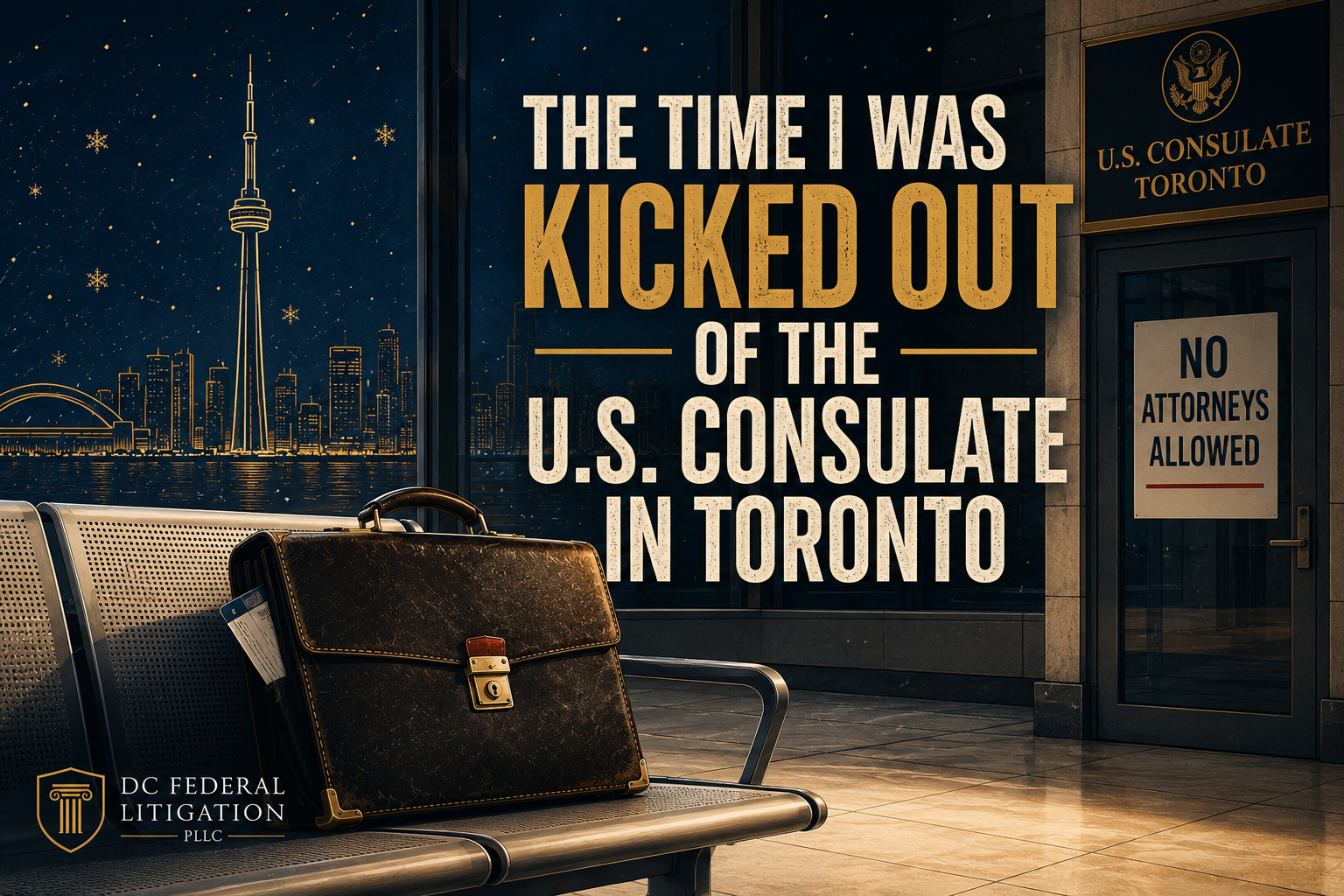
Good News, I'm in Toronto. Bad News, I'm in Toronto.
A reflection on the time I flew to a Canadian consulate to save a TV show production from a P-1 denial, got kicked out before I could open my briefcase, and learned something I have not stopped thinking about since: consistent adjudication is not a luxury for the people on the receiving end of it. It is the whole business.
By Sherrod D. Seward, Esq. | DC Federal Litigation PLLC
Reading time: ~10 minutes
There is a particular kind of phone call you make to a client when you are sitting in another country, with a briefcase full of contingency plans, and the only thing you actually have to offer them is a punchline.
I made one of those calls from Toronto.
The promoter picked up. I told him I had good news and bad news. He asked which one I wanted to give him first. I said: "The good news is, I'm in Toronto." He said, great. I said: "The bad news is, I'm in Toronto."
He understood immediately. He had been in this game long enough to know that a lawyer is not in Toronto on a Tuesday afternoon for a good reason. A lawyer is in Toronto because something has gone wrong, and the only place it can still be fixed is on the other side of the border. He laughed, the way you laugh at a thing that is genuinely funny and also genuinely terrible.
I have been thinking about that phone call for a long time. Not because of the joke, although the joke still lands. But because of what put me in the position to need the joke in the first place.
This is a story about that.
The Tool, Before the Story
I want to back into the story, because the story does not make sense without the strategy. And the strategy does not make sense without understanding a piece of P and O visa practice that most practitioners never use to the limits it can go to.
The P-1 visa is for athletes and entertainment groups. The O-1 is for individuals of extraordinary ability. Both visa categories have a companion category for the people who travel with the principal — P-1S for essential support staff to a P-1, and O-2 for essential support staff to an O-1. These categories exist on paper. Most filings never use them. They sit there like an unused tool in a toolbox most lawyers do not know is in the drawer.
Here is what the unused tool can actually do. On a single P-1S or O-2 petition, you can include as many as twenty-five beneficiaries on one filing. One I-129. One filing fee. One adjudication. Twenty-five people who can enter the United States together, on the strength of the principal's approved petition, as essential support to that principal's work.
That is a powerful structure when you have a group of people who need to travel together, who do not all independently meet the eligibility criteria for their own free-standing petitions, but who can credibly be shown to support the work of someone who does meet the criteria. It saves filing fees. It saves timing. It collapses what would otherwise be a stack of separate cases into one well-supported, well-documented petition.
The other piece of this that most practitioners never test: technically, you are only supposed to get O-2 essential support staff alongside O-1B petitioners — the arts and entertainment side of the O-1. The O-1A side, which covers sciences, business, athletics, and education, is supposed to be a solo category.
But the regulation does not always match the reality. We have been successful, over the years, getting O-2 visas issued alongside O-1A petitioners when the work involves athletics that operates inside a production or entertainment framework. Combat sports is the cleanest example. A combat sports promoter is technically running a business — an O-1A profile — but the business being run is a televised theatrical production. The cameras, the lighting, the production crew, the broadcast partners, the press, the choreography of a fight card from walkout to walkout: all of it reads, in the right hands and on the right record, as theatrical production. And when the record supports it, USCIS has approved the O-2 essential support staff alongside the O-1A principal.
That is how some of the biggest combat sports promoters in the world ran their first events in the United States. The promoter on the O-1A. The production crew on O-2 essential support visas. One coordinated strategy, one filing structure, one set of approvals, one event that actually got made.
That is the toolbox. Now the story.
The TV Show
One particular client was producing the second season of a television show in the United States. The roster was heavy with younger athletes — talented, real, doing the work — but most of them did not individually have the kind of competition record that would carry a free-standing P-1 athlete petition. A few of them did. The rest were going to need a different path.
The strategy we built was straightforward. We would file P-1 petitions for the most accomplished athletes on the roster — the ones whose records carried the burden on their own. Those would be the anchor cases. Then we would file P-1S essential support petitions for the rest of the group, on the theory that the supporting athletes had been training together with the anchors, touring together with the anchors, and actively promoting each other's careers as part of a single coordinated effort that the anchors could not credibly undertake without them.
That was not a fiction. It was the actual structure of the operation. These were athletes who had been in the same rooms, on the same mats, in the same gyms, on the same press tours, in the same hotel hallways for years. The training was collective. The promotion was collective. The product the audience saw on the screen was the product of an interlocking group of people, not of a handful of headliners performing in front of strangers.
To make the record airtight, we held a press conference in the United States for the event. I was there. The reporters were there. I had the chance to explain to the room what the situation was — that the work being done by the supporting athletes was the kind of essential support that the regulation contemplates, that the group had a documented history of training and promoting together, that the production could not credibly happen without the full roster. The reporters listened. And then, without being asked, they each wrote glowing support letters describing the operation as they had observed it. I have done a lot of things in this practice. I have rarely had a record build itself the way that record built itself in a hotel ballroom after a press conference.
The petitions went in. The evidence was strong. The theory was clean. The supporting letters were unusually good.
And then USCIS started signaling that the anchor P-1 might not be approved.
Why That Was a Catastrophe
A P-1S essential support petition cannot exist in the air. It is a derivative status. It exists only as long as there is a principal P-1 to support. If the anchor P-1 falls, every P-1S that was filed in reliance on it falls with it.
That is the architecture of the category. It is what makes the structure powerful when it works. It is also what makes it fragile when the anchor wobbles. One adjudicator's unfavorable reading of one principal petition does not just hurt one petitioner. It collapses the entire downstream structure of every support visa that was built on top of it.
So when the signaling on the anchor case started turning bad, I was not just looking at one denial. I was looking at the possibility that a full television production roster — the principal, the supporting athletes, the schedule, the venues, the broadcast partner, the sponsors, the advertisers, the crew, the camps — was about to evaporate over a single adjudication.
I packed my bags and flew to Toronto.
The Flight
The fighters were hoteled in Toronto for their consular processing the next day. I knew that if the anchor came back denied, or if the adjudication on the anchor cascaded into denials on the supports, I would need to be in the same building as the consulate to triage in real time.
I wrote a list on the plane. ESTA for the ones eligible. B-1 for the ones who could credibly be characterized as coming for legitimate business meetings. Whatever creative downgrades or alternative categories I could deploy in the four to twelve hours I might have between learning the bad news and the moment a fighter walked up to the interview window. None of these would let them perform in the United States. But some of them would let them enter the United States, buy time, and let me work the case from inside the country instead of from across a border.
That is what the briefcase contained. Contingencies. Backups. Alternatives. The kind of things you write down on a legal pad when you are not sure what the next move is, but you know that having no move is the only move you cannot afford.
The Line
I went to the consulate with the fighters. I stood with them in the line. I went all the way to the front of the line — not in some procedural sense, but physically, all the way to the interview window. I was standing right there with them, ready to introduce myself, ready to explain the situation, ready to deploy whatever contingency had to be deployed.
And it was only at that moment — at the window, with the officer's eyes on us — that the officer asked the question.
Does anyone here have an attorney with them.
I said I was the attorney. And I was, with all due politeness, asked to leave the consulate.
I sat outside. I waited.
The news, when it came, was mostly not good.
The Punchline
I called the promoter from outside the consulate.
"I have good news and bad news."
"Which one do you want first?"
"The good news is, I'm in Toronto."
He paused. "Okay. Great."
"The bad news is, I'm in Toronto."
He laughed. Because of course. A lawyer is not in Toronto on a Tuesday afternoon for a good reason.
That is the story. It happened. The case went where it went. Some of the roster made it in on other categories. Some of it did not. The show went on with a roster I had to rebuild in real time, in another country, on someone else's clock, with a briefcase of contingencies on a hotel desk and a phone that did not stop ringing.
What the Story Is Really About
I have told this story to a lot of practitioners over the years. It usually gets a laugh. The joke is genuinely good. But the joke is not what the story is about.
The story is about what happens to an entire ecosystem of working people when a single adjudication wobbles on a record that should have produced a clean approval.
Set aside the lawyer for a second. The lawyer made it home. The lawyer survived getting kicked out of a consulate. The lawyer told the story at conferences for years. Lawyers are fine. We are paid to absorb this kind of thing.
Look at everyone else who was on that case.
The promoter had committed to a venue. The broadcaster had committed to a date. The advertisers had bought slots against the date. The athletes had built training camps around the calendar. The crew had planned paychecks around the production. The sponsors had built activation campaigns around the lineup. The agent had told the client, in good faith, that this strategy would work — because the strategy did work, when the regulation was applied to the record the way the regulation is supposed to be applied.
All of those people — the promoter, the broadcaster, the advertisers, the athletes, the crew, the sponsors, the agent — were depending on a single adjudication being decided the same way as every other comparable adjudication had been decided. They were not asking for a favor. They were not asking for a stretch. They were asking for the rule, applied to their record, the same way the rule had been applied to records like theirs in the past.
When the adjudication does not work that way — when one officer's reading of one case can collapse the entire downstream of a production — what is at stake is not just the petitioner. What is at stake is every business that depends on the petitioner. Which is every business that touches the international sports economy, the entertainment economy, the creative economy, the touring economy, the international athlete economy, the production economy, the broadcast economy.
It is, in other words, a lot of economy.
Adjudication consistency is the business model.
What I Mean By That
When I talk about consistent adjudication, I do not mean that every petition should be approved. I do not even mean that hard cases should be resolved in the petitioner's favor. Those are different conversations.
What I mean is this. Every petition should be evaluated against the regulation, on the strength of the evidence, the same way every other comparable petition is evaluated against the regulation on the strength of comparable evidence. The petitioner is entitled to predictability. The business that depends on the petitioner is entitled to predictability. The country that benefits from the work the visa enables is entitled to predictability.
Consistent adjudication is the floor, not the ceiling. The petitioner can still lose. But the petitioner should not lose because the adjudicator decided the regulation says something it does not say. The petitioner should not lose because two adjudicators looking at the same record reach opposite conclusions for reasons neither one writes down. The petitioner should not lose because the rules quietly changed sometime between the filing and the decision and no one put the change in writing.
Those are the patterns that put lawyers on airplanes to Toronto. Those are the patterns that put productions on the brink of collapse two weeks before broadcast. Those are the patterns that turn a strong record into a denial, and turn a denial into a phone call where the lawyer has to make a joke because the joke is the only thing left.
Why I Flew to Toronto, And Why I File Cases Now
The reason I flew to Toronto is the same reason I file federal court complaints today. When the system works the way it is supposed to, neither thing is necessary. When the system does not work the way it is supposed to, both things become the only options left.
You can let the case die in the consulate window, or you can show up with a briefcase of contingencies, get kicked out, and call your client with a joke because the joke is the only currency you have left at that moment.
I do not want any of my clients to ever be in that position again.
That is why the firm I run now is built around federal court litigation against agency overreach. That is why I file mandamus actions when an agency sits on a petition past every reasonable timeline. That is why I file APA challenges when an agency invents requirements that are not in the regulation. That is why I am pursuing FOIA litigation against USCIS in my own name. Because the alternative is more flights to Toronto. And there is nothing romantic about a flight to Toronto when a production is on the line.
The Last Word
I told my client that day that the good news was that I was in Toronto. The bad news was that I was in Toronto. He laughed, because he understood the joke. I laughed too.
I have not laughed about it since.
A practice that delivers a stable rule, applied the same way to every petitioner who meets it, would have meant I never had to make that flight. The production would have gone on. The athletes would have arrived on time. The cameras would have rolled. The promoter would have called me to say thank you, not to ask which one of us wanted the good news first.
When adjudication works, you do not see lawyers. You see athletes performing, productions filming, businesses operating, crews loading trucks, fans buying tickets, sponsors signing contracts, broadcasters running shows.
When adjudication breaks, you see me at an airport, holding a briefcase, dialing a number, looking for a punchline.
Let's keep working until the punchlines are not necessary anymore.
About the Author
Sherrod D. Seward, Esq. is the founder and managing attorney of DC Federal Litigation PLLC. He concentrates his practice on federal court litigation against U.S. Citizenship and Immigration Services and other federal agencies, with a particular focus on P-1, O-1, and EB-1A visa denials and USCIS mandamus actions. Earlier in his career he founded Sherrod Sports Visas, where he has represented Filipino basketball players, combat sports athletes, motorsports drivers, and management companies across multiple sports.
This article is provided for informational purposes only and does not constitute legal advice. It does not address any specific client matter and should not be read as commenting on any pending immigration adjudication. Identifying details of the matter described have been generalized for client confidentiality.