
8(a) Certification Denied? Your Options Explained
Understanding your options after SBA denies your 8(a) Business Development Program application
Introduction
The SBA's 8(a) Business Development Program provides significant advantages to qualifying small businesses owned by socially and economically disadvantaged individuals. But many applications are denied.
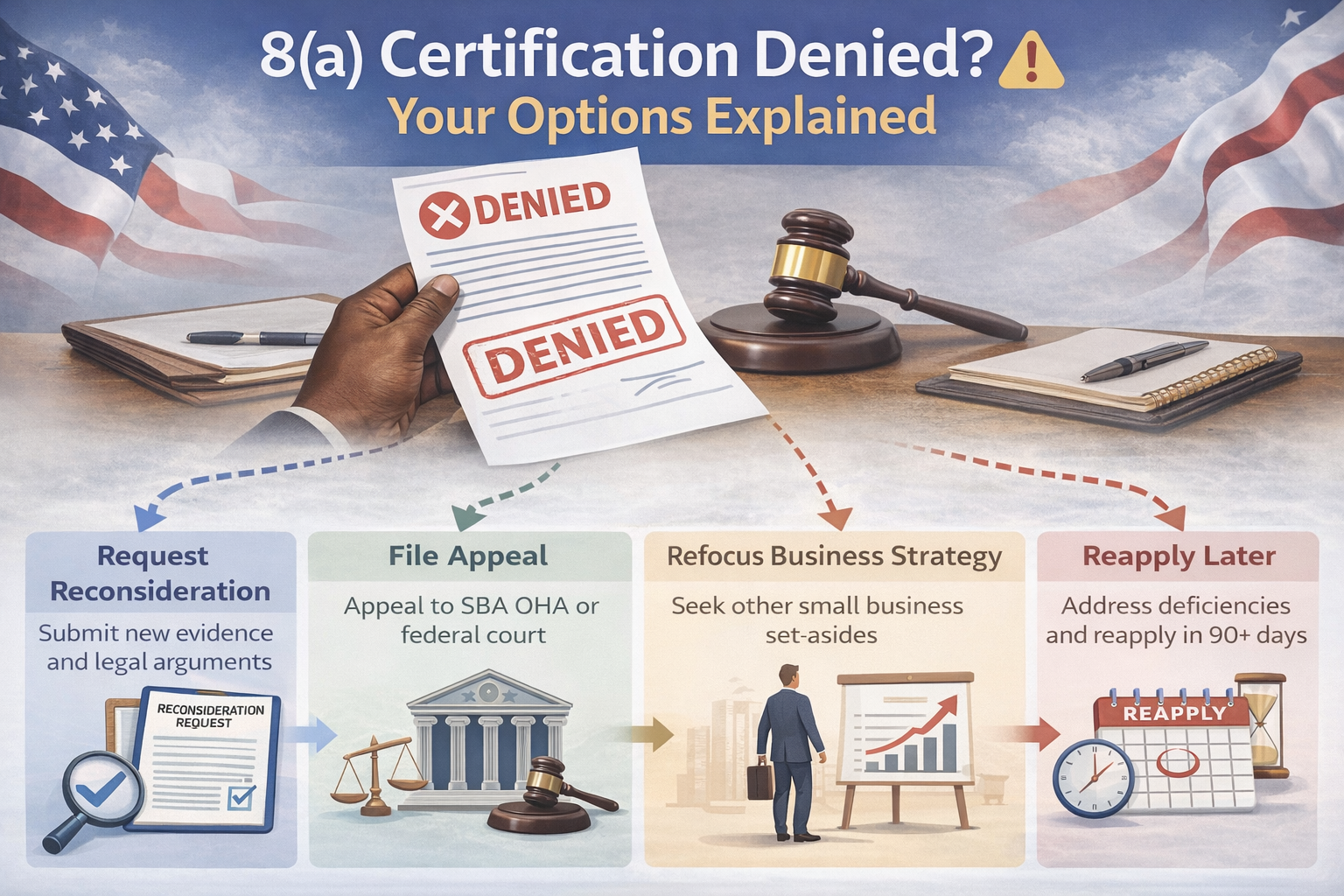
If your 8(a) application was denied, you have options. This guide explains why denials happen, how to appeal, and strategies for moving forward.
Understanding the 8(a) Program
What is 8(a)?
The 8(a) Business Development Program is named after Section 8(a) of the Small Business Act. It provides:
Access to sole-source and set-aside federal contracts
Business development assistance
Mentorship opportunities
Contracting advantages for nine years
Who Qualifies?
To qualify for 8(a), the business must be:
A small business (per size standards)
At least 51% owned by socially and economically disadvantaged individuals
Controlled by those individuals
In business for at least two years (waivable)
Demonstrating potential for success
The owner must be:
A U.S. citizen
Socially disadvantaged (membership in designated group or individual determination)
Economically disadvantaged (personal net worth under $850,000, excluding primary residence and business interest)
In control of daily and long-term business operations
Common Reasons for 8(a) Denial
Economic Disadvantage Issues
Net Worth Exceeds Limit: SBA may determine that the owner's personal net worth exceeds the $850,000 threshold. Common issues:
Asset valuation disputes
Treatment of retirement accounts
Business ownership interests
Real estate holdings
Excessive Personal Income: Income exceeding approximately $400,000 in any of the preceding three years may disqualify.
Asset Transfers: Recent transfers of assets to qualify may be disallowed.
Social Disadvantage Issues
Individual Social Disadvantage Not Established: If not a member of a designated group, you must demonstrate individual social disadvantage through specific, documented incidents.
Insufficient Documentation: Failure to provide adequate evidence of discrimination or disadvantage.
Control and Ownership Issues
Unconditional Ownership Not Established: SBA may find that ownership is conditional or encumbered.
Lack of Control: SBA may determine that the disadvantaged owner does not control daily and long-term business decisions.
Management by Non-Disadvantaged Individuals: If non-disadvantaged managers have excessive authority, control may be questioned.
Business Issues
Size Standard Exceeded: The business exceeds small business size standards for its primary NAICS code.
Two-Year Rule Not Met: Business has not been in operation for at least two years (and waiver not granted).
Potential for Success Not Demonstrated: SBA is not convinced the business can succeed.
Previous 8(a) Participation: Prior participation in 8(a) (personally or through another firm) may bar participation.
Application Deficiencies
Incomplete Application: Missing required documents or information.
Inconsistent Information: Information in the application contradicts tax returns, financial statements, or other evidence.
Failure to Respond to RFI: SBA issues requests for additional information; failure to respond adequately results in denial.
Understanding Your Denial Letter
Review Carefully
Your denial letter should explain:
Specific grounds for denial
Regulatory basis for the decision
Appeal rights and deadlines
Identify the Issues
Understand exactly what SBA found deficient:
Is it a factual dispute?
Is it a documentation issue?
Is it a fundamental eligibility problem?
The nature of the issue determines your best path forward.
Option 1: Request Reconsideration
When Appropriate
Reconsideration is appropriate when:
You have additional evidence addressing the denial grounds
There was a factual error in SBA's analysis
You can clarify misunderstandings
Process
File reconsideration request within regulatory timeframe
Provide additional documentation
Address each ground for denial specifically
SBA reviews and issues new decision
Limitations
Reconsideration is not appropriate for:
Appealing legal interpretations
Challenging SBA policy
Disputing regulatory requirements
Option 2: Appeal to SBA Office of Hearings and Appeals (OHA)
When Appropriate
OHA appeal is appropriate when:
SBA misapplied regulations
SBA made legal errors
SBA's factual findings are clearly erroneous
Due process was violated
Jurisdiction
OHA has jurisdiction to hear appeals of:
8(a) certification denials
8(a) terminations
Certain other 8(a) program decisions
Process
Filing Deadline: Appeals must be filed within 45 days of denial decision.
Petition Requirements:
Identify the decision being appealed
State grounds for appeal
Provide supporting argument and evidence
Comply with OHA procedural rules
Briefing:
Petitioner files opening brief
SBA files response
Petitioner may file reply
Decision: OHA Administrative Judge reviews the record and issues written decision.
Standard of Review
OHA reviews whether SBA's decision was:
Based on clear error of fact
Based on error of law
Arbitrary, capricious, or contrary to law
OHA gives deference to SBA's factual findings but reviews legal conclusions independently.
Possible Outcomes
Affirm: Denial upheld
Reverse: Denial overturned, certification granted
Remand: Return to SBA for further review
Option 3: Federal Court Challenge
When Appropriate
Federal court (COFC or district court) may be appropriate when:
OHA appeal exhausted
Constitutional issues raised
Fundamental legal challenge to SBA action
Limitations
Federal courts generally give deference to agency decisions. Overturning an SBA denial in court is difficult unless there was clear legal error.
Process
File complaint in appropriate court within applicable statute of limitations. Litigation follows standard federal court procedures.
Option 4: Reapplication
When Appropriate
Reapplication is appropriate when:
Circumstances have changed
Deficiencies can be corrected
Waiting period has passed
Waiting Period
After denial, you typically must wait one year before reapplying. This waiting period may not apply if denial was based on correctable deficiencies.
Improving Your Application
Before reapplying:
Address all grounds for denial
Strengthen documentation
Resolve ownership/control issues
Ensure accurate and consistent information
Consider professional assistance
Strategies for Success
Document Everything
Comprehensive documentation is essential:
Personal financial statements with supporting documents
Business tax returns and financial statements
Evidence of social disadvantage (if individual determination)
Corporate documents (operating agreement, bylaws)
Resumes demonstrating owner control
Address Economic Disadvantage Carefully
If net worth is an issue:
Ensure accurate asset valuation
Document excluded assets properly
Explain asset transfers (if any)
Provide complete financial picture
Establish Control Clearly
Demonstrate that the disadvantaged owner:
Makes strategic and day-to-day decisions
Has authority over management
Controls the business operationally
Social Disadvantage Documentation
If not a member of a designated group:
Document specific incidents of discrimination
Show how discrimination impacted career/business
Provide corroborating evidence where possible
Consistency is Critical
Ensure all documents tell the same story:
Tax returns match financial statements
Resume matches job history claims
Corporate documents reflect stated ownership
Working with an Attorney
When to Get Help
Consider an attorney when:
Denial reasons are complex
OHA appeal is warranted
Reapplication requires significant restructuring
Control or ownership issues need resolution
What an Attorney Can Do
Analyze denial and identify best path forward
Prepare OHA appeal petition and briefs
Assist with reapplication documentation
Restructure ownership/control to meet requirements
Represent you before OHA
Frequently Asked Questions
-
OHA appeals must be filed within 45 days of the denial decision. Act promptly.
-
Generally, you should complete the appeal process before reapplying. Consult with counsel on the best strategy.
-
Review your asset calculations carefully. Certain assets (primary residence, retirement accounts under specific circumstances) may be excluded. Ensure proper valuation and documentation.
-
While not required, OHA proceedings involve legal briefing and procedural requirements. Many successful appellants have counsel.
-
Success rates vary based on the grounds for denial and quality of the appeal. Cases with strong legal arguments or clear factual errors have better chances.
-
Generally, once you've used your one-time 8(a) participation, you cannot participate through another firm. There are limited exceptions.
-
The two-year rule can be waived. If denied on this ground, consider requesting a waiver with evidence of business success and potential.
Don't Give Up
An 8(a) denial is disappointing, but it's not necessarily the end. Many businesses successfully appeal or reapply after addressing SBA's concerns.
Keys to success:
Understand exactly why you were denied
Choose the right path forward (appeal, reconsideration, or reapplication)
Address deficiencies comprehensively
Document everything thoroughly
Consider professional assistance
Get Help With Your 8(a) Denial
DC Federal Litigation Counsel assists businesses with 8(a) certification denials and appeals.
We provide:
Denial analysis and strategy consultation
OHA appeal preparation and representation
Reapplication assistance
Ownership/control restructuring advice
Contact:
Email: sba@dcfederallitigation.com
Phone: 956-224-9372 , +1 (202) 999-3631
