
COFC vs GAO Bid Protests: Choosing Your Forum
Comparing the Court of Federal Claims and Government Accountability Office for protest filings
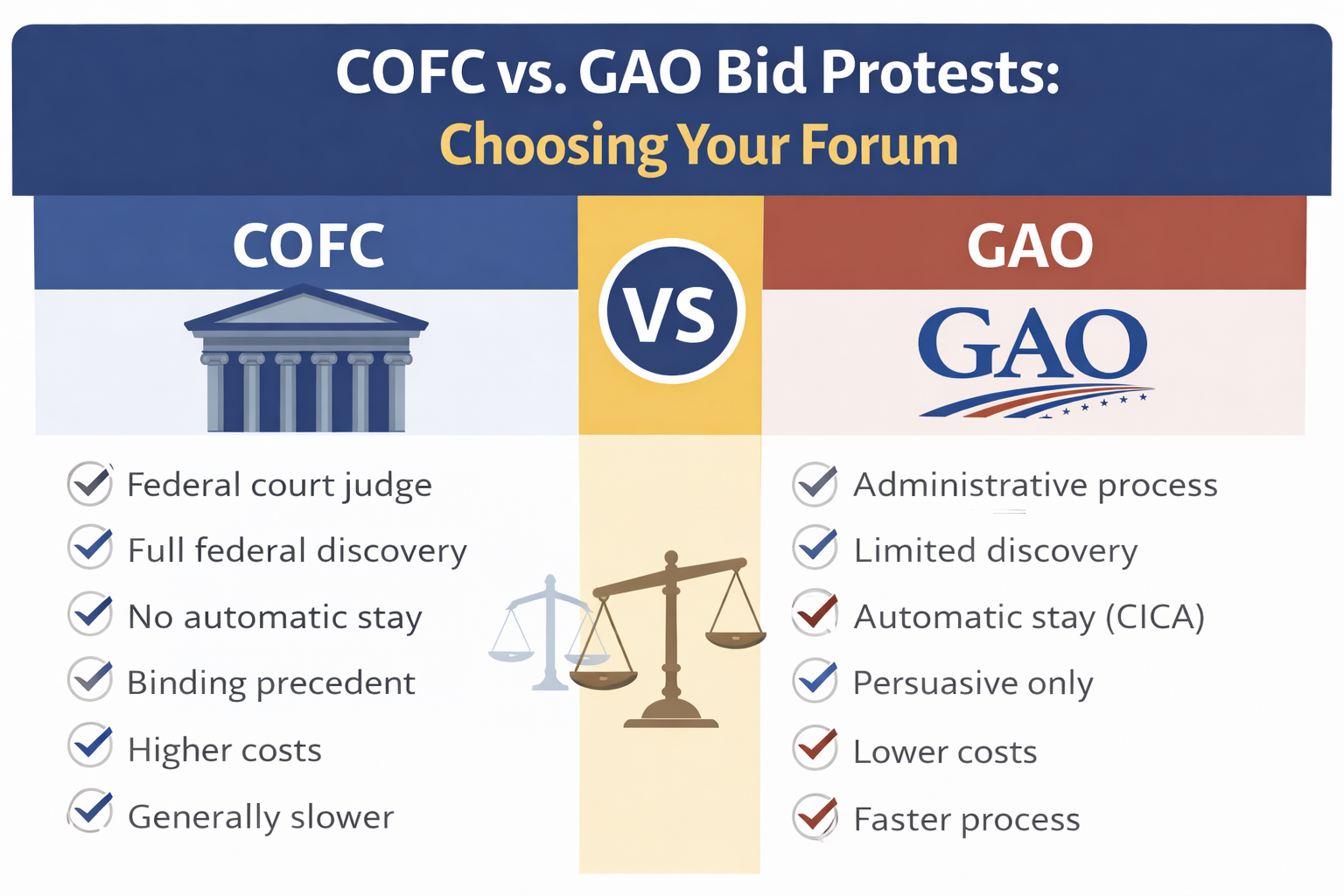
Introduction
When a federal contractor believes a procurement was conducted improperly, two primary forums exist for challenging the award: the Government Accountability Office (GAO) and the U.S. Court of Federal Claims (COFC). Each forum has distinct advantages and disadvantages.
This guide compares the two options to help contractors make informed decisions about where to file their protests.
| Factor | GAO | COFC |
|---|---|---|
| Timeline | 100 days (strict) | 6-12 months typical |
| Automatic Stay | CICA stay (30 days to override) | Injunction required |
| Discovery | Limited | Full federal discovery |
| Protective Order | Standard form available | Court-approved protective order |
| Filing Fee | None | $402 |
| Decision-Maker | GAO attorneys | Article III judges |
| Precedent | Non-binding recommendations | Binding judicial decisions |
| Corrective Action | Agency may take voluntarily | Court orders |
| Appeal | Federal Circuit | Federal Circuit |
| Legal Standard | Reasonable basis | Same, with judicial scrutiny |
GAO Bid Protests
Overview
The Government Accountability Office is an agency within the legislative branch that reviews bid protests. GAO is the most common forum for bid protests, handling thousands of cases annually.
Timeline
100-Day Deadline: GAO must issue a decision within 100 calendar days of protest filing. This is a statutory requirement that GAO meets consistently.
Express Option: For simpler protests, GAO offers a 65-day express option.
Extensions: The 100-day clock stops for corrective action, supplemental protests, or other procedural events.
CICA Stay
The Competition in Contracting Act (CICA) provides an automatic stay of contract performance:
Timing: Stay applies if protest filed within 10 days of contract award (or 5 days after debriefing for certain procurements)
Duration: Stay continues pending GAO decision
Override: Agency head can override stay based on urgent/compelling circumstances (within 30 days)
Effectiveness: Most agencies honor the stay; overrides are relatively rare
The CICA stay is a significant advantage of GAO protests—you get automatic relief without having to seek a court injunction.
Discovery
GAO discovery is limited:
Agency Report: Agency must produce the contracting officer's statement and relevant documents
Comments: Protester comments on agency report
Supplemental Submissions: Limited additional filings
No Depositions: GAO does not allow depositions or interrogatories
No Subpoenas: Cannot compel third-party documents
For protests requiring extensive fact-finding, GAO's limited discovery may be insufficient.
Decision-Maker
GAO protests are decided by GAO attorneys, not judges. While GAO attorneys are experienced in procurement law, they are not Article III judges with constitutional independence.
Outcomes
If GAO sustains the protest:
GAO recommends corrective action
Agency usually complies (compliance rate ~99%)
GAO can recommend attorney fee reimbursement
If GAO denies the protest:
Protester can appeal to COFC (not Federal Circuit directly)
Decision has no precedential value
Pros of GAO
Speed: 100-day timeline provides quick resolution
Automatic Stay: CICA stay without injunction motion
No Filing Fee: Free to file
Experience: GAO handles thousands of protests annually
Streamlined Process: Less formal than court litigation
Cons of GAO
Limited Discovery: Cannot conduct depositions or subpoena documents
Non-Binding: GAO issues recommendations, not orders
Less Scrutiny: Not a judicial forum with Article III independence
Appeal Path: Must go to COFC first, then Federal Circuit
COFC Bid Protests
Overview
The U.S. Court of Federal Claims is an Article I federal court with jurisdiction over bid protests. COFC provides a more formal judicial process with full discovery and binding decisions.
Timeline
COFC cases typically take 6-12 months, though expedited handling is possible. Unlike GAO's 100-day deadline, COFC timelines are case-specific.
Factors affecting timeline:
Case complexity
Discovery needs
Briefing schedules
Court calendar
Injunctive Relief
COFC does not have an automatic stay like GAO. To stop contract performance, you must:
File Motion for Temporary Restraining Order (TRO)
File Motion for Preliminary Injunction
Meet Injunction Standards:
Likelihood of success on merits
Irreparable harm
Balance of hardships
Public interest
Obtaining an injunction is not automatic and requires demonstrating entitlement to equitable relief.
Discovery
COFC provides full federal discovery:
Document Requests: Request relevant documents from agency and intervenors
Interrogatories: Written questions requiring sworn answers
Depositions: Examine witnesses under oath
Requests for Admission: Establish undisputed facts
Subpoenas: Compel testimony and documents from third parties
For protests involving disputed facts, witness credibility, or complex technical issues, COFC discovery is invaluable.
Decision-Maker
COFC judges are Article I judges with substantial independence and lifetime appointments (during good behavior). Many COFC judges have extensive procurement law experience.
Outcomes
If COFC rules in your favor:
Court issues binding orders
Can order injunctive relief
Can declare award improper
Can award bid preparation costs
Can award attorney fees (in certain circumstances)
If COFC rules against you:
Appeal directly to Federal Circuit
Pros of COFC
Full Discovery: Depositions, document requests, subpoenas
Judicial Independence: Article I judges, not agency employees
Binding Decisions: Court orders, not recommendations
Direct Appeal: Federal Circuit appeal without intermediate step
Precedential Value: Decisions create binding precedent
Cons of COFC
No Automatic Stay: Must seek injunction
Longer Timeline: 6-12+ months typical
Filing Fee: $402 court filing fee
More Formal: Full litigation process
Higher Costs: Discovery and litigation expenses
When to Choose GAO
GAO is Often Better When:
Time is Critical If the procurement has a tight timeline and you need resolution quickly, GAO's 100-day deadline provides certainty.
CICA Stay is Valuable If stopping contract performance is essential and you can file within the CICA stay window, GAO provides automatic relief.
Limited Discovery Needed If the protest can be resolved based on the procurement record without depositions or third-party discovery, GAO's streamlined process works.
Cost is a Factor GAO's free filing and shorter timeline reduce costs compared to COFC litigation.
Straightforward Legal Issues If the protest raises clear violations of procurement regulations without disputed facts, GAO can resolve efficiently.
Common GAO Protest Grounds
Evaluation errors
Unequal treatment
Flawed discussions
Source selection errors
Organizational conflicts of interest
Improper solicitation terms
When to Choose COFC
COFC is Often Better When:
Discovery is Essential If you need depositions, interrogatories, or third-party documents to prove your case, COFC is the only option.
Complex Technical Disputes If the case involves disputed technical evaluations requiring expert testimony or cross-examination, COFC provides the forum.
Automatic Stay Not Available If you missed the CICA stay deadline, COFC allows you to seek injunctive relief (though not automatic).
Precedent Matters If the case raises important legal issues where binding precedent would benefit you, COFC decisions have precedential value.
Prior GAO Denial If GAO denied your protest and you believe the decision was wrong, COFC provides de novo review.
Larger Contract Value For high-value contracts justifying litigation investment, COFC's more thorough process may be worthwhile.
Common COFC-Appropriate Issues
Credibility disputes
Fraud allegations
Complex technical evaluations
Cases requiring expert testimony
Appeals from GAO denials
Situations where full discovery is necessary
Dual Filing Strategy
Filing in Both Forums
Some protesters file in both GAO and COFC simultaneously or sequentially:
Advantages:
Preserves both options
Can pursue GAO for speed while COFC proceeds
Discovery in COFC can inform GAO protest
Disadvantages:
Double the cost and effort
Court may stay COFC case pending GAO
Agency may take corrective action at GAO, mooting COFC case
Sequential Filing
GAO First, Then COFC:
Try GAO's faster, cheaper process
If GAO denies, pursue de novo review at COFC
COFC First:
Less common
Appropriate when CICA stay is unavailable and injunction is needed immediately
Cost Comparison
GAO Costs
| Item | Cost |
|---|---|
| Filing Fee | $0 |
| Attorney Fees | $15,000-$50,000+ |
| Expert Witnesses | Rare (limited discovery) |
| Total Typical Range | $15,000-$50,000 |
COFC Costs
| Item | Cost |
|---|---|
| Filing Fee | $402 |
| Attorney Fees | $50,000-$200,000+ |
| Expert Witnesses | $10,000-$50,000+ |
| Discovery Costs | Variable |
| Total Typical Range | $75,000-$300,000+ |
Frequently Asked Questions
-
Yes, but there are strategic considerations. COFC may stay proceedings pending GAO decision. Dual filing increases costs. Consult with counsel on the best strategy.
-
You can still file at GAO (within 10 days of award or debriefing, whichever is later), but won't get the automatic stay. Alternatively, file at COFC and seek injunctive relief.
-
You cannot appeal GAO decisions directly to the Federal Circuit. You must first file at COFC for de novo review, then appeal COFC's decision to the Federal Circuit.
-
GAO sustains approximately 15-20% of protests decided on the merits. However, many protests result in corrective action before decision. COFC success rates are similar.
-
If you're the awardee and the disappointed offeror protests, you should consider intervening to protect your interest. Intervention allows you to participate in the proceedings.
-
At GAO, the agency must file a report within 30 days explaining its procurement decisions and producing relevant documents. The protester then comments on the report.
Need Help Deciding?
DC Federal Litigation Counsel represents contractors in bid protests at both GAO and COFC. We can evaluate your situation and recommend the best forum.
We handle:
GAO protests
COFC bid protests
Injunction motions
Post-award disputes
Corrective action implementation
Federal Circuit appeals
Contact:
Phone: 956-224-9372 , +1 (202) 999-3631
